

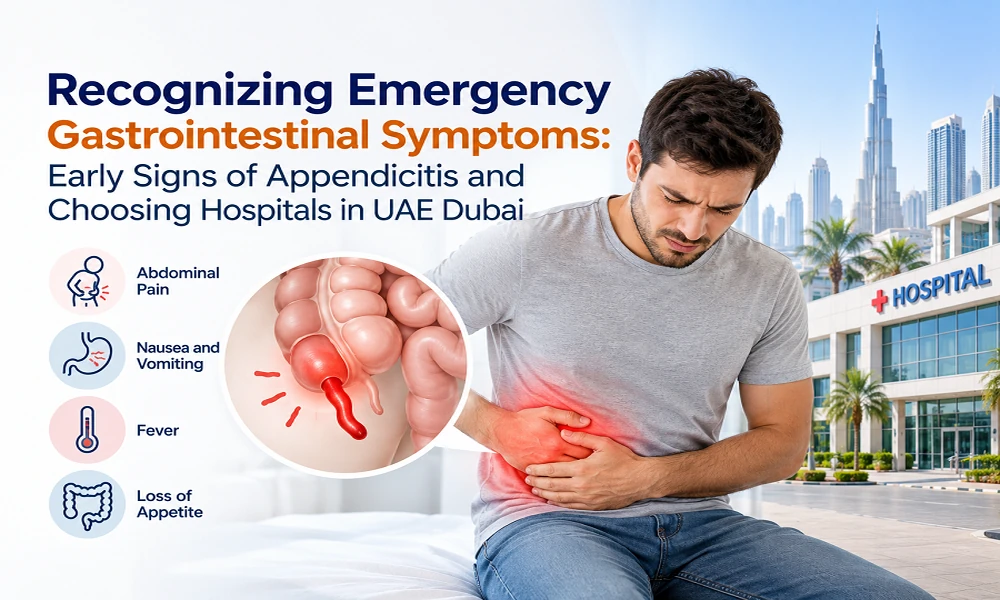
Gastrointestinal discomfort is one of the most common reasons individuals seek medical consultation globally. While many instances of abdominal distress stem from benign conditions such as mild gastroenteritis, dietary indiscretions, or functional bowel disorders, certain symptoms demand immediate medical intervention. Acute appendicitis represents one of the most frequent surgical emergencies encountered in emergency departments worldwide. Recognizing the early symptoms of this condition is vital to preventing complications such as appendix perforation, localized abscess formation, or generalized peritonitis.
Understanding the physiological markers of acute appendicitis and knowing how to evaluate emergency healthcare infrastructure-particularly when seeking top-tier clinical care at hospitals in UAE Dubai-can make a decisive difference in patient outcomes.
Understanding Acute Appendicitis: Pathophysiology and Onset
The vermiform appendix is a small, finger-shaped pouch attached to the cecum at the junction of the small and large intestines in the lower right quadrant of the abdomen. Although its exact physiological role remains a subject of ongoing clinical study, it contains lymphoid tissue that contributes to local mucosal immunity.
Acute appendicitis occurs when the lumen of the appendix becomes obstructed. Common causes of luminal obstruction include:
- Fecaliths: Hardened, compacted stool masses that block the appendiceal opening.
- Lymphoid Hyperplasia: Swelling of the intestinal lymphoid tissue, often triggered by viral or bacterial infection.
- Foreign Bodies or Strictures: Less common anatomical barriers that impede mucus drainage.
Once the obstruction occurs, mucosal secretions accumulate within the obstructed segment, rapidly increasing intraluminal pressure. This pressure compromises venous and lymphatic drainage, leading to tissue ischemia, inflammation, mucosal ulceration, and bacterial overgrowth. If untreated, ischemic necrosis progresses, culminating in appendiceal perforation-a life-threatening event that floods the peritoneal cavity with infectious matter.
Early and Evolving Signs of Appendicitis
Clinical presentation of acute appendicitis can vary significantly depending on the patient’s age, anatomical variations of the appendix (such as a retrocecal or pelvic position), and the presence of underlying health conditions. However, a classic clinical sequence occurs in a majority of cases.
1. Visceral Pain Phase
The hallmark early sign of acute appendicitis is a dull, aching pain that begins around the umbilical region or upper abdomen. Because visceral innervation from the midgut travels via sympathetic nerves back to the T10 spinal cord level, early pain is poorly localized and diffuse. Patients often mistake this initial discomfort for indigestion, gas pain, or general stomach upset.
2. Somatic Pain Migration
As inflammation progresses over a period of 12 to 24 hours, the parietal peritoneum (the sensitive lining of the abdominal wall) becomes irritated. This shifts the nature and site of the pain. The discomfort shifts from the periumbilical region to the right lower quadrant of the abdomen, specifically localized at McBurney’s Point-located approximately two-thirds of the distance along an imaginary line drawn from the umbilicus to the anterior superior iliac spine. At this stage, the pain becomes sharp, constant, and localized.
3. Gastrointestinal Disturbance
Accompanying the shifting pain, patients frequently experience systemic gastrointestinal symptoms:
- Anorexia: A distinct loss of appetite is one of the most reliable early diagnostic indicators.
- Nausea and Vomiting: Typically occurring after the onset of pain rather than preceding it.
- Altered Bowel Habits: Constipation or mild diarrhea may occur, though neither is pathognomonic.
4. Low-Grade Fever and Systemic Markers
A low-grade fever ranging between 37.5°C and 38.5°C (99.5°F to 101.3°F) is common during the early inflammatory stages. A sudden rise to high-grade fever, accompanied by rigors, often indicates advanced complications such as perforation or abscess formation.
5. Physical Examination Findings
During physical evaluation, clinicians look for specific signs of peritoneal irritation:
- Rebound Tenderness: Pain that intensifies upon the sudden release of deep pressure on the right lower quadrant.
- Guarding: Involuntary contraction of the abdominal wall muscles to protect the inflamed organ.
- Rovsing’s Sign: Deep palpation of the lower left quadrant elicits pain in the lower right quadrant due to peritoneal shifting.
- Psoas and Obturator Signs: Increased abdominal pain caused by passive extension or internal rotation of the hip joint, indicating irritation of adjacent pelvic musculature.
When to Seek Emergency Care
Because appendicitis can progress from early mucosal inflammation to gangrene and rupture within 24 to 72 hours, immediate medical evaluation is necessary whenever persistent, worsening lower right abdominal pain occurs.
Seeking immediate emergency care is essential if abdominal pain is accompanied by high fever, repeated vomiting, severe abdominal rigidity, or signs of systemic sepsis such as rapid heart rate, confusion, or extreme weakness. Early diagnosis through clinical examination, laboratory tests (such as elevated white blood cell counts and C-reactive protein), and diagnostic imaging (abdominal ultrasound or contrast-enhanced CT scans) drastically lowers the risk of surgical complications.
Evaluating Healthcare Infrastructure for Acute Care in UAE Dubai
Dubai has established itself as a premier destination for high-quality medical services, boasting world-class healthcare facilities, advanced diagnostic technology, and international clinical accreditation. When sudden gastrointestinal emergencies arise, knowing how to evaluate emergency care standards across hospitals in UAE Dubai is critical for patients seeking prompt and effective surgical intervention.
Key elements to evaluate when selecting emergency healthcare facilities include:
1. 24/7 Emergency Department Readiness
Acute appendicitis requires round-the-clock diagnostic and surgical support. Leading facilities maintain fully equipped emergency departments staffed by board-certified emergency medicine physicians, critical care nurses, and on-call general surgeons capable of taking a patient to theatre without delay.
2. Advanced Diagnostic Imaging Capabilities
Accurate and rapid imaging is vital to confirm appendicitis and rule out mimic conditions such as renal colic, gynecological disorders, or diverticulitis. High-caliber emergency departments feature point-of-care ultrasound equipment and high-resolution 64-slice or 128-slice CT scanners available 24 hours a day to minimize diagnostic delays.
3. Minimally Invasive Laparoscopic Surgery
The clinical standard for appendectomy is modern laparoscopic (keyhole) surgery. Compared to traditional open surgery, laparoscopic appendectomy yields significantly shorter hospital stays, reduced postoperative pain, minimal scarring, and faster return to normal daily activities. Advanced emergency surgical facilities prioritize minimally invasive surgical techniques for both uncomplicated and complicated appendicitis cases.
4. Multidisciplinary Clinical Support and Intensive Care
Complicated cases of appendicitis involving rupture, peritonitis, or sepsis demand multidisciplinary care involving general surgeons, gastroenterologists, infectious disease specialists, and critical care professionals. Facilities equipped with dedicated Intensive Care Units (ICU) and advanced infection control protocols ensure comprehensive post-operative recovery support.
Conclusion
Recognizing early signs of appendicitis -from initial periumbilical pain migration to localized right lower quadrant tenderness-is vital for preventing severe abdominal complications. In the event of acute abdominal pain, seeking immediate emergency evaluation ensures timely diagnostic confirmation and surgical resolution. Facilities operating within Dubai offer state-of-the-art diagnostic imaging, 24/7 emergency surgical readiness, and minimally invasive care, ensuring optimal patient outcomes during critical gastrointestinal emergencies.